By Dr Steve Freeman, Director, Renewable Energy Partners
Introduction
The timing of the South West Business Council’s ‘Resilience for Growth’ conference could not have been better. Just eight days before it opened at the University of Exeter, the government launched its ‘Be Ready’ campaign, encouraging households to prepare for potential disruptions to electricity, water, and communications [1]. For me, that timing brought into focus who ultimately carries the burden of resilience. Are we asking households, businesses and communities to absorb the shocks of systemic vulnerability? Is societal resilience measured by how much disruption people can endure, or by how effectively foundational systems are designed, connected and managed?
In reality, top-down system hardening and bottom-up personal preparedness must work together. Yet household readiness has limits, and the more reliably our foundational systems are designed to absorb shocks, the less disruption households face.
Building that resilience into our energy systems is already part of network planning. Ofgem, for example, has approved £28.7 billion of upfront investment from 2026 to 2031 to strengthen the safety, security and resilience of energy networks [2]. Whilst infrastructure upgrades alone cannot eliminate every outage, personal preparedness helps households manage residual disruption on the ground. Together, they act as complementary partners in building national resilience.
At the conference, speakers stressed the importance of collaboration. The South West’s energy, maritime, defence, research and natural assets give the region clear scope to put that principle into practice. Planning how those capabilities work together can help protect essential services and give businesses a firmer basis for investing in the region.
Hidden dependencies
Britain’s essential services rest on infrastructure most people never see. Subsea pipelines supply around three-quarters of the UK’s gas, and subsea cables carry 99% of its international data traffic [3]. Offshore wind adds further critical links. According to The Crown Estate, offshore wind met 19% of UK electricity needs in 2025, supplied by 2,820 turbines and nearly 4,000 km of export cables [4]. Alongside these physical vulnerabilities, digital threats are compounding the risks. The National Cyber Security Centre handled more than three times as many nationally significant incidents in 2025 as it did in 2022 (Figure 1) [5]. In its latest review, it warns of persistent and evolving cyber pressure across critical UK infrastructure [6].
Figure 1: Nationally significant cyber incidents handled by the NCSC, 2021–22 to 2024–25.
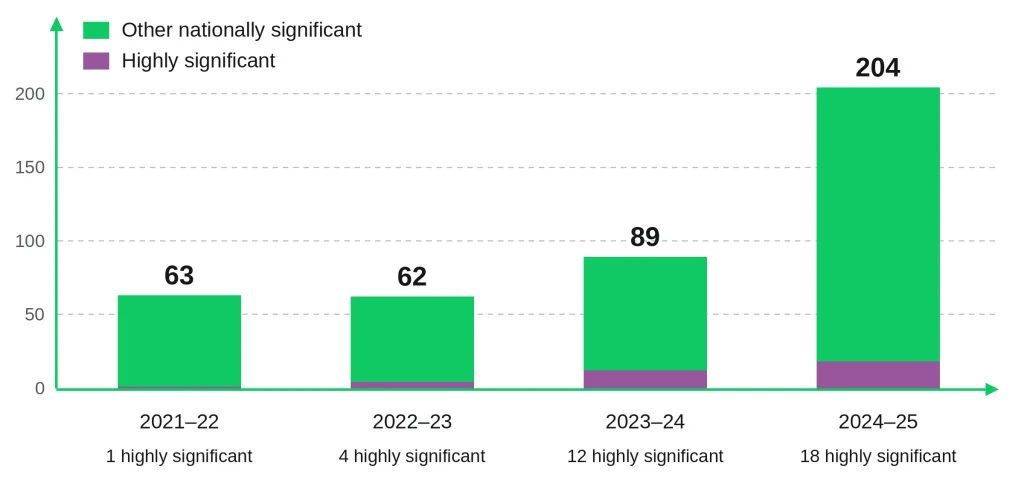
Source: Author’s analysis, REP Ltd, using NCSC (2025) Annual Review data [5]. The series covers incidents handled by the NCSC across all sectors.
The trajectory of these serious and unpredictable threats is clear, and it exposes the limits of public preparedness. Households and businesses can prepare for a power cut, yet neither can defend the grid or repair a damaged subsea cable. That responsibility rests on the design, coordination and management of the systems themselves.
The South West sits at the heart of several hidden dependencies. The region hosts the landing points for most of the UK’s transatlantic subsea cables alongside the emerging Celtic Sea floating offshore wind sector [7, 8]. In addition, critical defence capabilities exist at the Royal Navy base in Devonport, the largest naval base in Western Europe, and a growing maritime cyber security research facility at the University of Plymouth [7, 9]. At the same time, regional partners are strengthening long-term energy security through initiatives such as the Dorset Clean Energy Super Cluster [9].
Yet linking systems together carries both risk and resilience. Without deliberate architectural planning, interconnected infrastructure can spread disruption, but when carefully designed, it offers alternative routes, resources and capabilities when one part fails [10]. Few regions are better placed than the South West to show how these systems can be engineered to absorb shocks rather than cascade into wider disruption.
Systemic Resilience
The South West’s railway network offers a clear example of resilience delivered through cross-sector collaboration. Rhys Evans, Project Manager at Network Rail, highlighted historic vulnerabilities on the Chipping Sodbury line, where infrastructure built through a complex aquifer system nearly 120 years ago now faces unprecedented climate pressures and incurred £10.38 million in delay-related costs between 2018 and 2024.
The response extends beyond the railway boundary. Rather than relying solely on raising tracks, improving drainage and installing pumps, Network Rail is working with the Environment Agency and local partners on longer-term solutions, including exploring nature-based solutions to store floodwater upstream of the Hele and Bradninch crossing in Devon [11, 12].
This same ‘resilience by design’ principle applies to energy and wider regional infrastructure. How individual assets perform matters alongside the risks they share and the alternatives available when circumstances change.
When Storm Desmond flooded Lancaster’s electricity substation in December 2015, about 61,000 properties lost power [13]. The disruption affected communications, electronic payments and access to fuel [13]. Similar cascading dependencies matter in the South West when a storm or drought puts pressure on several services at once.
A failure in one part of the system can rapidly compromise several others [10]. That reality matters for households, but equally for businesses and regional economies. A port, factory or research facility may be well designed and independently resilient, yet when external power, water, transport, digital communications or supply chains falter, its operations can still fail. As Nicky Cunningham, Associate Dean at the University of Exeter, highlighted, organisations often optimise for such tight efficiency that they quietly breed fragility. Weakness in any single dependency can bring the whole operation to a standstill.
The same dynamic shapes the energy transition itself. Diversifying domestic clean power reduces exposure to volatile fossil fuel markets, while storage and flexibility help manage shifts in supply and demand [14]. However, shared bottlenecks can still expose multiple projects to the exact same disruption, whether they rely on a constrained grid connection, a single port, a specialist supplier or a scarce pool of skilled workers [10].
For the South West, the practical question is which connections can reduce those risks and which give projects and essential services a workable alternative by designing for resilience.
Connected Resilience
The South West offers a practical example of the conference’s theme of resilience for growth. From Hinkley Point C and planned floating offshore wind in the Celtic Sea to data centres, defence hubs and specialist research institutes, the region holds a rich energy and industrial base. Speakers highlighted that growth depends on reliable water, transport and digital services supporting these activities. To explore how the region’s capabilities might connect, I mapped a selection of these assets alongside examples raised at the conference (Figure 2).
Figure 2: Connecting the South West’s capabilities. A schematic illustration. Solid lines show documented projects or partnerships. Dashed lines show possible connections.
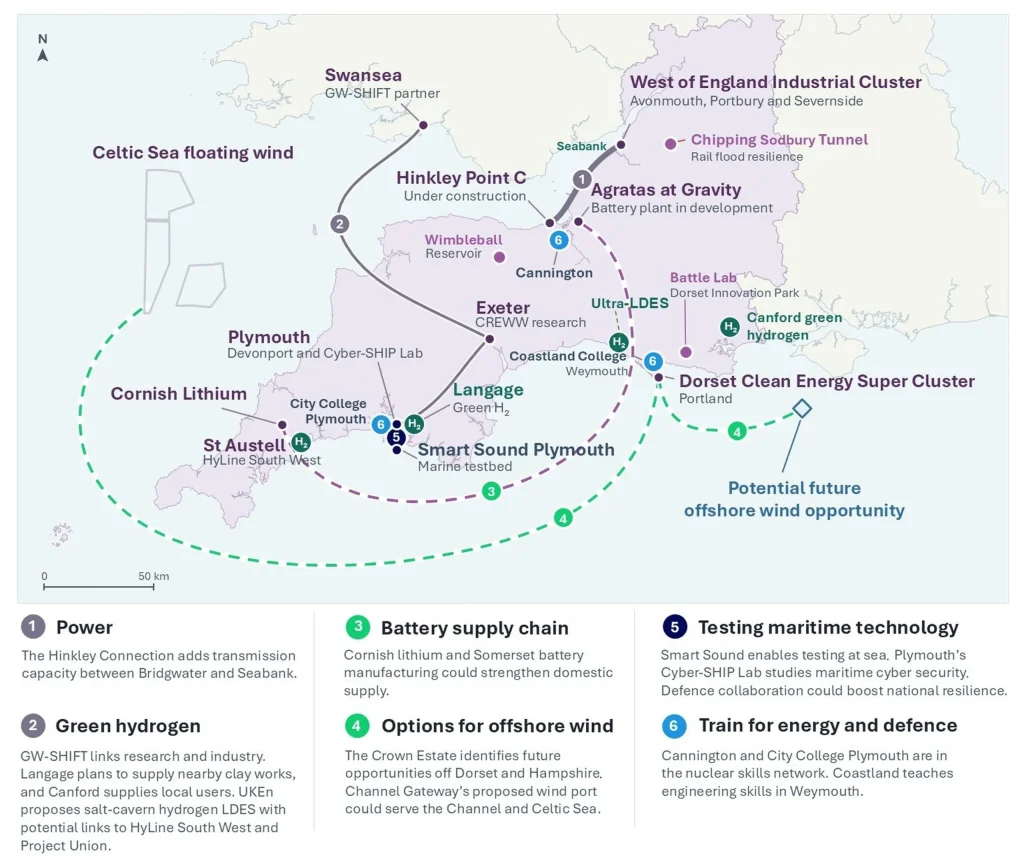
Source: Author’s own analysis, REP Ltd drawing on conference and published project material.
Mapping connections and interdependencies reveals where single point failures might cascade. Alan Burrows, Director of Environmental Regulation at Pennon Group, described how low flows in the River Exe limited abstraction and increased reliance on Wimbleball Reservoir, where storage fell to 15%. Water availability must therefore be considered alongside grid capacity when planning water intensive activities [15].
Mo Mohoboob, Senior Solutions Architect at Amazon Web Services, illustrated the opposite approach. Digital services designed to run across separate cloud zones can keep operating during a single zone outage provided each zone maintains independent power, cooling and network connections. For the region, the planning questions are what each place needs to keep functioning, what it can draw on elsewhere, and what it can provide in return.
The strategic planning frameworks needed to answer questions like these are already taking shape. In England, spatial development strategies can identify infrastructure needs across council boundaries [16]. Alongside them, the National Energy System Operator Strategic Spatial Energy Plan is mapping potential locations for electricity and hydrogen generation and storage, while Regional Energy Strategic Plans are being developed to inform network investment [17, 18]. The real opportunity lies in joining these mechanisms across sectors rather than treating energy, water and digital networks in isolation. The Environment Agency has already called for energy and regional water planners to work together on future demand [15]. The conference showed the importance of testing critical services against shared disruption scenarios to expose where growth requires extra capacity or an alternative supply.
In the South West, the Dorset Clean Energy Super Cluster brings together proposals for fixed-bottom offshore wind, salt cavern hydrogen storage, and the Channel Gateway port facility at Portland [19]. While the port remains at the feasibility stage, it could offer a valuable alternative port facility to service floating and fixed-bottom offshore wind alongside manufacturing [20]. The salt caverns could provide ultra-long duration energy storage for hydrogen network users [21]. If delivered, these facilities could support local regeneration and provide options for the wider energy system, illustrating how resilience could support growth.
Designing Resilience
Decisions about where and how we connect infrastructure determine what keeps working when part of a system fails. After the North Hyde substation fire led Heathrow Airport to close, the Government called on infrastructure operators to assess their energy dependencies and prioritise secure connections and backup power from the earliest stages of development [22]. The same principle applies across the South West. Identifying where multiple projects rely on the same facility helps determine where to prioritise early investment in backup capacity and shared infrastructure.
Celtic Sea floating offshore wind offers a clear example. Earlier this year, the Government announced up to £64 million for design and engineering work on a proposed expansion of Port Talbot to support assembly and deployment [23]. If several projects rely on the same assembly berth, a delay in upgrading could push back construction schedules. That is why cross project coordination is already being delivered by the Celtic Sea Cluster and the Celtic Sea Forum to give suppliers and developers a way to identify bottlenecks [24]. Adding a new facility at the proposed Channel Gateway in Portland could also give developers an alternative route [20].
To take coordination a step further, Celtic Sea Power’s regional master planning tool maps the entire floating wind ecosystem, from offshore projects and ports to grid connections and workforce capabilities [25]. It uses critical path analysis to evaluate how a delay in one component would affect the broader system, helping regional partners identify shared vulnerabilities and alternatives.
Building on that systemic view, not every opportunity needs to be developed immediately, nor should every uncertainty become a reason for inaction. Upstream tools such as The Crown Estate’s Marine Delivery Routemap help identify where further offshore investigation is worthwhile [26]. The aim is to establish what evidence is needed for the next proportionate decision, which risks can be managed, and what new information would justify changing course. This puts into practice Nicky Cunningham’s call to expose hidden dependencies and test real world constraints before fragility is built into the system.
The Government’s ‘Be Ready’ campaign has brought resilience into people’s homes. The next challenge is ensuring the infrastructure systems supporting those homes, businesses and communities are resilient. The South West can lead the way by showing what resilience by design looks like in practice. That means delivering not just new assets, but connected capabilities and adaptable systems that strengthen national security while driving regional growth.
References
[1]. Cabinet Office (2026) Households encouraged to take small, simple steps to stay prepared in an emergency. GOV.UK news story, 22 October. Available: https://www.gov.uk/government/news/households-encouraged-to-take-small-simple-steps-to-stay-prepared-in-an-emergency.
[2]. Ofgem (2025) RIIO-3 Final Determinations Overview Document. Decision, 4 December. London: Ofgem. Available: https://www.ofgem.gov.uk/sites/default/files/2025-12/RIIO-3-Final-Determinations-overview.pdf (Accessed: 2026, 9 November).
[3]. HM Government (2026) Critical Undersea Infrastructure Security and Resilience: Proposals for modernising the UK’s legislation. White Paper, CP 1683, 22 October, Chapter 1. Available: https://www.gov.uk/government/consultations/proposals-for-new-legislation-to-strengthen-the-security-and-resilience-of-critical-undersea-infrastructure-cui/critical-undersea-infrastructure-security-and-resilience-proposals-for-modernising-the-uks-legislation-white-paper (Accessed: 2026, 12 November).
[4]. The Crown Estate (2026) UK Offshore Wind Report 2025. London: The Crown Estate. Available: https://www.datocms-assets.com/136653/1778587764-26-05-12_tce_osw_report2025_final.pdf (Accessed: 2026, 9 November).
[5]. National Cyber Security Centre (2025) ‘Incident management’, in NCSC Annual Review 2025. London: NCSC. Available: https://www.ncsc.gov.uk/collection/ncsc-annual-review-2025/chapter-01-cyber-threat-to-the-uk/incident-management (Accessed: 2026, 8 November).
[6]. National Cyber Security Centre (2026) ‘The impact of AI on cyber threat’, in NCSC Annual Review 2026, 3 November. Available: https://www.ncsc.gov.uk/collection/annual-review-2026/understanding-threat/ai-impact-cyber-threat (Accessed: 2026, 12 November).
[7]. Great South West (2024) Great South West Independent Economic Review: Securing the UK’s Economic Future. November. Available: https://greatsouthwest.co.uk/wp-content/uploads/2024/11/24Q4-GSW-2024-IER-FULL-R3.pdf.
[8]. The Crown Estate (2026) Final site progressing for Round 5 as Ocean Winds enters agreement for lease for floating wind farm in the Celtic Sea. 3 March. Available: https://www.thecrownestate.co.uk/news/final-site-progressing-for-round-5 (Accessed: 2026, 12 November).
[9]. Great South West (2024) The Great South West: A Clean Energy Powerhouse. Energy prospectus, November. Available: https://greatsouthwest.co.uk/wp-content/uploads/2024/11/GSW-Energy-Prospectus_2024_FINAL.pdf (Accessed: 2026, 9 November).
[10]. National Infrastructure Commission (2020) Anticipate, React, Recover: Resilient Infrastructure Systems. May, Chapters 1 and 3. Available: https://digital4planning.com/wp-content/uploads/2021/04/Resilience-Anticipate-React-Recover-28-May-2020.pdf (Accessed: 2026, 12 November).
[11]. Network Rail (2026) Annual State of Nature 2024. January, p. 151, ‘Connecting the Culm’. Available: https://www.networkrail.co.uk/wp-content/uploads/2026/01/Annual-State-of-Nature-report-2024.pdf#page=151 (Accessed: 2026, 12 November).
[12]. Network Rail (n.d.) Nature-based Solutions (NbS). Available: https://greener.networkrail.co.uk/a_to_z/nature-based-solutions-nbs/.
[13]. Royal Academy of Engineering, Institution of Engineering and Technology and Lancaster University (2016) Living without electricity: One city’s experience of coping with loss of power. London: Royal Academy of Engineering, May, pp. 3–4 and 6. Available: https://raeng.org.uk/media/xrrigg0m/raeng-living-without-electricity.pdf.
[14]. Department for Energy Security and Net Zero (2024) Clean Power 2030 Action Plan: A new era of clean electricity. December. Available: https://www.gov.uk/government/publications/clean-power-2030-action-plan/clean-power-2030-action-plan-a-new-era-of-clean-electricity-main-report.
[15]. Environment Agency (2025) ‘Taking action on water for energy’, in National Framework for Water Resources 2025, Chapter 7. Available: https://www.gov.uk/government/publications/national-framework-for-water-resources-2025-water-for-growth-nature-and-a-resilient-future/7-taking-action-on-water-for-energy-national-framework-for-water-resources-2025.
[16]. Planning and Infrastructure Act 2025, c. 34, s. 58, inserting s. 12D(4) into the Planning and Compulsory Purchase Act 2004. Available: https://www.legislation.gov.uk/ukpga/2025/34/section/58.
[17]. National Energy System Operator (2025) Strategic Spatial Energy Plan Methodology. May, section 1.3, p. 11. Available: https://www.neso.energy/document/360501/download (Accessed: 2026, 11 November).
[18]. National Energy System Operator (n.d.) Regional Energy Strategic Planning (RESP). Available: https://www.neso.energy/what-we-do/strategic-planning/regional-energy-strategic-planning-resp.
[19]. Dorset Council (2025) Energising Dorset’s Economy. Clean energy prospectus, pp. 7–8. Available: https://www.investindorset.com/userfiles/files/Prospectus%2015%20MAY%202025%20DIGITAL%20COPY%20KW_CP%281%29.pdf.
[20]. Dorset Council (2026) Dorset Council backs Morwind feasibility study to drive growth and power Dorset’s future. 26 January. Available: https://www.dorsetcouncil.gov.uk/news/dorset-council-backs-morwind-feasibility-study-to-drive-growth-and-power-dorset-s-future-1.
[21]. UK Oil & Gas Plc (2026) Annual Report 2025. Operational Review, ‘Long Duration Energy Storage (LDES) Assets’. Available: https://www.ukogplc.com/ul/UKOG-ARA-FS%202025%20FINAL.pdf.
[22]. Department for Energy Security and Net Zero (2025) NESO’s North Hyde report: government response. 18 November, executive summary and Part 3, ‘Embedding power resilience across CNI’. Available: https://www.gov.uk/government/publications/nesos-north-hyde-report-government-response/nesos-north-hyde-report-government-response-accessible-webpage.
[23]. Department for Energy Security and Net Zero (2026) £64 million for Port Talbot offshore wind hub in the Celtic Sea. 26 March. Available: https://www.gov.uk/government/news/64-million-for-port-talbot-offshore-wind-hub-in-the-celtic-sea.
[24]. Marine Energy Wales (2026) Celtic Sea developers join forces to maximise offshore wind benefits for Wales and the South West. Available: https://www.marineenergywales.co.uk/developer-news/celtic-sea-developers-join-forces-to-maximise-offshore-wind-benefits-for-wales-and-the-south-west/.
[25]. Celtic Sea Power (2025) Celtic Sea FLOW Master Planning: Executing Britain’s Industrial Strategy Using Regionally Guided Multi-Project Scheduling. Executive summary, section 1.5, p. 7. Available: https://celticseapower.co.uk/wp-content/uploads/2025/11/CSP-Master-Planning-Document-pr3-Ex-Sum-and-Intro.pdf.
[26]. The Crown Estate (2024) Marine Delivery Routemap. 11 September. Available: https://www.thecrownestate.co.uk/our-business/marine/Marine-Delivery-Routemap#downloads (Accessed: 2026, 12 November).

About the Author
Steve Freeman is an environmental and energy consultant with 30+ years’ experience in offshore wind and marine energy. He co-founded the Queen’s Award-winning Renewables Consulting Group and was shortlisted for Advocate of the Year at the 2026 reNEWS National Wind Energy Awards.