Reflections and summary: Vice Admiral (Rtd) Andrew Burns CB OBE
Introduction
The SWBC conference, hosted by the University of Exeter, explored resilience at all levels and brought together academics, the armed forces and the business community to share perspectives, experiences and solutions. It made a contribution to the necessary national conversation that needs to take place to raise awareness and stimulate a societal response in order to be better prepared for a major crisis.
Achieving national resilience for growth requires a clear definition of what resilience means at individual, organisational, regional and national scales. This is particularly true at a time when we exist in a brittle, anxious, non-linear and incomprehensible (B-A-N-I) environment. For the UK, our high degree of integration into the global economic and geopolitical system and our geography are strengths but also present vulnerabilities in our resilience to disruption.
We must plan for the unexpected or even what may hitherto have been regarded as unthinkable, such as major climate-change-driven events. The volatility we are experiencing at every scale will require rapid learning from failure and the adaptability to respond when the situation changes.
Key Deductions
1. We need to recognise the mega-trends that are impacting growth and our lifestyles for what they are. The geo-political and geo-economic trends are changing at an alarming rate, but we must face up to the reality of them, accept that much is not within our control, and adapt accordingly.
- The leadership challenge is to ensure evidence-based and data-driven decision-making and prioritise accordingly.
- We must prepare for failure, acknowledging its inevitability, and put mechanisms in place to learn quickly, which might present an organisational culture challenge for leaders.
2. Success requires cross-sector collaboration, which requires us to understand the interconnections across the ecosystem we inhabit either as individuals or as organisations.
- A systems approach helps considerably in doing so and in understanding our vulnerabilities. Only then can we begin to formulate workable mitigations.
- A good example is how nature-based solutions are supporting a more resilient transport system.
3. Effective communication at every level is essential, both internally and externally, and tailored to the audience.
- We must make the narrative around resilience coherent regionally and nationally. Only then will we change behaviours. There may be lessons to be learned from the HIV campaigns of the 1980s and the C19 pandemic.
- This is about maintaining competitive advantage for growth, and the language around sovereignty may need to change, e.g. around supply chains for rare earths, microchips, radioactive isotopes, AI.
- A societal conversation is required.
4. Ultimately this all depends on people and human resilience: individual citizens and those who make up the workforce of our businesses and institutions.
- How can we make the most of our human capital and the expertise vested in our people?
- We need to balance the regulatory environment with the outcomes required. Only then will we achieve the optimum level of risk tolerance and allow the space for innovation.
- It is important for leaders to gauge how all this is perceived by their people in order to judge individual and collective resilience.
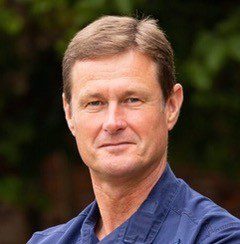
Andrew Burns was appointed Fleet Commander in September 2021 and commanded all operational arms of the Royal Navy (Surface Flotilla, Submarine Flotilla, Fleet Air Arm, Royal Marines and Royal Fleet Auxiliary). This included their generation for task and operational effectiveness. He was the Chief Naval Warfare Officer and the Gender Advocate for the Royal Navy.
Andrew joined the Royal Navy in 1989 as a University Cadet.
He has been privileged to command the mine countermeasures vessel HMS Berkeley, the frigate HMS SOMERSET and the amphibious assault ship HMS BULWARK. He was appointed OBE in 2015. Promoted to Commodore, he commanded the Amphibious Task Group, which included a period in command of the US Fifth Fleet Combined Task Force 50 as the Principal Warfighting Commander. More recently, he was Commander United Kingdom Strike Force, the Royal Navy’s deployable 2* operational commander, and Rear Admiral Surface Ships, the head of the Surface Flotilla Fighting Arm.